
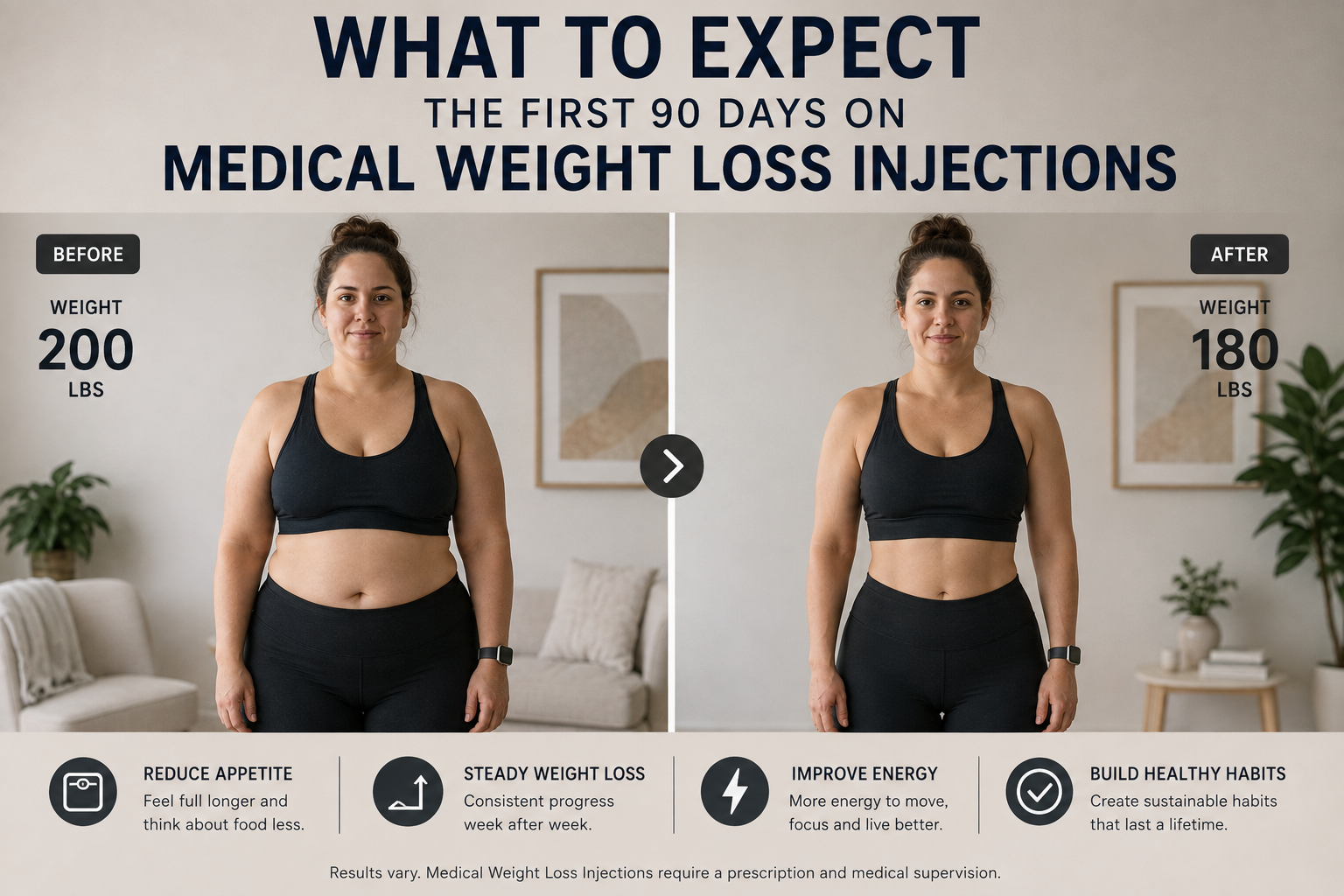
Most people researching medical weight loss have already read the headline numbers and seen the before and after photos. What is much harder to find is a plain description of what the experience is actually like week to week.
So here it is. What genuinely happens, roughly when it happens, and what surprises people along the way.
One note before we start. Everyone responds differently. Your starting point, your metabolism, your medical history, and your dose all shape the timeline, and this is a general picture rather than a promise.
Medical Weight Loss Injections are prescription medications that act on the same hormone signals your gut already uses to tell your brain you have eaten enough.
In practical terms, they do three things. They slow how quickly food leaves your stomach, so you stay full longer. They reduce appetite signaling, so you think about food less. And they help regulate blood sugar, which smooths out the crashes that drive snacking.
That last part matters more than people expect. A lot of eating is not hunger. It is a blood sugar dip at three in the afternoon that feels like hunger.
The first week is mostly about your body meeting the medication. Starting doses are deliberately low. Some people feel a noticeable appetite change within days. Others feel almost nothing at first, which is normal and not a sign that it is failing.
The most common early side effects are mild nausea, some fullness after smaller meals, and occasional constipation. Most of it is manageable, and most of it settles.
By week two or three, the thing people describe most is not physical. It is mental. The constant background negotiation about food quiets down. Patients describe leaving food on the plate without deciding to, or forgetting to eat lunch, which for many is a completely new experience.
This is also when the practical lesson lands. When you eat much less, what you eat matters far more. Protein and hydration become the whole ballgame. Skimp on protein and you will feel tired and lose muscle alongside fat, which is not the goal.
Typical month one loss is somewhere in the range of five to twelve pounds, and a share of that is water weight. That is normal, not a trick.
Month two is when things get real in both directions.
The medication dose usually steps up during this window, and appetite suppression becomes more consistent. Weight loss tends to settle into a steadier rhythm, often around one to two pounds a week, which is exactly where you want it. Faster is not better. Faster usually means muscle.
This is also when your clothes start telling the story before the scale does. Plenty of people drop a size while the number barely moves, because body composition is changing underneath.
Two things tend to catch people off guard in month two.
First, food preferences shift. Rich or greasy food can become genuinely unappealing. People who never liked vegetables suddenly do not mind them. Alcohol often loses its appeal entirely.
Second, social eating gets awkward. You are the person ordering an appetizer as a main course. Sitting through a long dinner while barely eating takes some adjusting to, and it is worth having a plan for how you want to handle questions from family and friends.
Month three is where the plateau usually shows up, and where a lot of people quit if nobody warned them it was coming.
Your body is adapting. You are carrying less weight, so you burn fewer calories doing the same things. The scale can stall for two or three weeks while you are doing everything correctly.
This is not failure. This is physiology, and it is the single most important thing to understand about the whole process. A plateau is a signal to look at protein intake, resistance training, sleep, and dose timing with your provider. It is not a signal to eat less and less, which backfires.
By the end of month three, most people are somewhere between fifteen and thirty pounds down from where they started, and the habits are beginning to feel less like effort.
This is the most important question on this page, and it deserves a direct answer.
If you stop the medication and nothing else has changed, appetite returns and weight typically follows. That is well documented and no clinic should tell you otherwise.
What makes the difference is what you built during your ninety days. Muscle preserved through protein and resistance training. Portion habits that persist because you practiced them. Better sleep and reduced alcohol. Patients who use this window to build those things hold their results far better than patients who treat the injection as the entire plan.
Think of the medication as making the change possible, not as being the change.
You will lose weight without exercising. You will lose the wrong kind of weight.
When you are in a large calorie deficit, your body takes from both fat and muscle. Resistance training two or three times a week tells your body to hold onto muscle. It does not need to be a gym membership or anything ambitious. Bands at home, bodyweight work, or a couple of dumbbells is enough to change the outcome meaningfully.
Protein does the same job from the other direction. Aim high, and drink far more water than feels necessary.
The common ones are nausea, constipation, fatigue in the early weeks, and occasional heartburn. They tend to be worst right after a dose increase and improve as you adjust. Eating slower and stopping earlier than you think you need to helps most of them.
Less commonly, people experience more significant digestive symptoms that require a dose adjustment. This is exactly why medical supervision matters. Weight loss injections obtained without a prescribing physician, without dose management, and without anyone monitoring you are a genuinely bad idea, whatever the price looks like.
There are also people who should not take these medications at all, including those with certain thyroid cancer histories, pancreatitis, or specific gastrointestinal conditions, and those who are pregnant or breastfeeding. Screening for that is part of a proper first appointment.
At our Wesley Chapel clinic, you start with a full medical evaluation including labs and history, not a five minute form. From there we see you regularly to review how you are responding, adjust dose deliberately rather than automatically, and track body composition rather than just weight on a scale.
That tracking distinction matters. Scale weight alone cannot tell you whether you lost fat or muscle, and those are two very different ninety days.
It tends to be a strong fit if you have weight to lose that has resisted repeated sincere efforts, if you have blood sugar or metabolic concerns alongside the weight, and if you are prepared to treat this as a medically supervised process rather than a shortcut.
It is a poor fit if you want to lose a few vanity pounds quickly, or if you are hoping to avoid changing anything about how you eat and move.
At New Tampa Wellness Clinic, Dr. Jose De La Torre reviews your history, orders appropriate labs, and tells you honestly whether this is the right path for you. If it is not, he will say so and talk through what would work better.
Learn more about our medical weight loss program, or contact our Wesley Chapel office to schedule. We are located at 2321 Crestover Ln, Suite A in Wesley Chapel, serving patients from New Tampa, Land O Lakes, Lutz, Zephyrhills, and across Tampa Bay. Call or text (813) 856-2070.
This article is for general education and is not medical advice. Medical Weight Loss Injections require a prescription and medical supervision. Individual results vary. Talk with a qualified physician about whether treatment is appropriate for you.